|
|
|
Blennerhassett Heraldry - Illustrated
|
|
|
|
|
ARMS: |
|
Gules, a chevron ermine, between three dolphins naiant embowed Argent
"in a red field, a chevron of ermine fur between 3 silver dolphins with body arched"
Rarely, the dolphins are depicted tincture "Azure" (blue) instead of "Argent" (silver/white).
In older representations the dolphins are always drawn as embowed, later as naiant embowed.
The 1808 grant of arms to Baronet Blennerhassett of Blennerville in Co.Kerry specifies naiant embowed.
In modern representations, the dolphins are often depicted, incorrectly, as "naiant but not embowed".
|
|
|
|
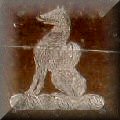
a wolf sejant Gules - rarely, "a wolf passant Gules" (as Sir Thomas Blennerhassett Kt 1531)
- sometimes, "a wolf sejant Proper"
- in East Anglia the wolf is sometimes described as a fox |
|
|
|
"Fortes Fortuna Juvat" in English: "Fortune favours the bold" or "Fortune favours the brave" | |
dolphins: naiant embowed
(correct for Blennerhassett) |
dolphins: naiant
(incorrect for BH) |
|
|
|
|
|
|
|
|
|
|
[plate] 63 click on image to enlarge
|
|
|
|
Sir Thomas Blenerhasset Knt, Frense Ch. Norf'k
Drawn, Etched & Published by J.S.Cotman, Yar[mouth] 1816 |
|
|
|
1816 etching by John Sell Cotman,
from his drawing made before July 1814, pub. in
“Sepulchral Brasses of Norfolk & Suffolk” as 2 vols 1839
This heraldically tinctured plate is from
[COTMAN 2nd ed. 1839 v.2 frontispiece plate 63]
accompanying description and a yellow coloured plate is on
[COTMAN 2nd ed. 1839 v.1 p.35 plate 63]
Sir Thomas Blennerhaysett, Knt d.1531 - of Frenze, Norfolk[in BLOMEFIELD 2nd ed. v.1 1805 p.142]
|
|
|
|
|
|
|
|
Effigy:
On an exceptional brass effigy , Sir Thomas Blenerhaysett, Kt is depicted in full armour with sword, dagger, gauntlets & spurs, wearing a tabard or surcoat of arms. "...His gauntlets are represented as lying on the stone at his feet, and conveniently show us the back and the method of jointing the fingers, by riveting little plates of steel to buff leather, while the uplifted hands of Sir Roger le Strange, 1506, have shown us how they were fastened on the hands. His pointed toes and sharp heels were uncommon at this time, when round heels were generally worn..."
[COTMAN 2nd ed. 1839 v.2 frontispiece plate 63]
Tabard:
The tabard and shoulder pieces display his family arms, quarterly:
1st Blennerhassett, 2nd Lowdham, 3rd Orton, 4th Kelvedon (Keldon).
Blennerhassett Crest:
His head rests on a helm supporting an unusual variation of the family crest, "a wolf passant" (walking) instead "a wolf sejant" (seated). |
|
|
|
Decoration:
Hanging from a chain around his neck, partly hidden by his hands"
"...upon his breast, he wears a cross patee,
perhaps the cross of St Mary, of Italy..."
[COTMAN 2nd ed. 1839 v.2 frontispiece plate 63]
|
|
|
The stone ledger slab on which Sir Thomas Blenerhaysett's effigy and inscription once lay is missing, but much of the brass survives.
Shields of arms:
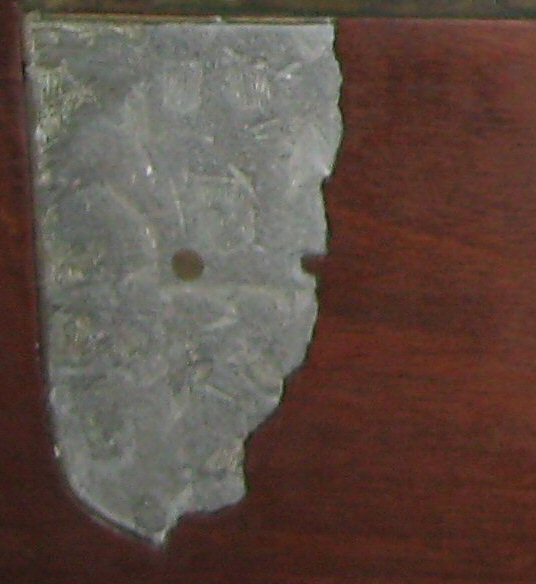
On a stone ledger slab (missing), with his effigy and his rectangular inscription brass, were formerly displayed four brass shields of arms.
No's 1. & 4. were seen by [L'ESTRANGE] in 1857. No's 3 & 4. are presently missing but No's 1. & 2. have survived, formerly orphaned but now displayed on the chancel wall, mounted below an inscription brass for his 2nd wife Margaret Blennerhassett, nee Braham.
|
|
|
1. (shield survives)
quarterly: 1st & 4th Blennerhassett, 2nd & 3rd Orton
(for his grandfather Ralph Blennerhassett, who descended from the Orton family of Cumberland)
impaling
quarterly: 1st & 4th Lowdham, 2nd & 3rd Kelvedon
(for his grandmother Joan Lowdham who descended from Kelvedon of Essex) |
|
|
|
2. (shield survives but is severely damaged, sinister side carrying Heigham arms is missing)
quarterly: 1st & 4th Blennerhassett, 2nd & 3rd Lowdham
(for his father John Blennerhassett whose mother was Joan Lowdham)
impaling
Heigham (for his mother Jane Heigham) |
|
|
|
3. (shield is missing)
quarterly: 1st Blennerhassett, 2nd Lowdham, 3rd Orton, 4th Kelvedon (Keldon)
(for himself, Sir Thomas Blennerhassett, descended from Lowdham, Orton & Kelvedon)
impaling
Braham, with a crescent for difference (for his 2nd wife Margaret Braham) |
|
|
|
4. (shield was present in 1857 but is now missing)
quarterly: 1st Blennerhassett, 2nd Lowdham, 3rd Orton, 4th Kelvedon (Keldon)
(for himself, Sir Thomas Blennerhassett, descended from Lowdham, Orton & Kelvedon)
impaling
Le Strange two lions passant (for his 1st wife Jane Le Strange)
arms of Le Strange (L'Estrange, L'Strange) of Hunstanton (Hunston) Hall, Co.Norfolk
(these are NOT the arms of Sutton)
in St Mary's church, Kenninghall, Norfolk (son of Sir Thomas Blennerhassett by 1st wife Jane)
is recorded as also Blennerhassett impaling L'Estrange
[BLOMEFIELD 2nd ed. v.1 KENNINGHALL pp.223-224] [ANSTIS Ms. E 265 f.29].
|
|
|
|
|
|
|
|
|
|
|
|
|
copyright © The British Library Board 2010
click on image to view full page
|
|
click on image to enlarge
|
|
photo: courtesy of Margaret Jones,
St Michael's Parochial Church Council, Workington
|
|
|
|
THOMAS JENYN'S BOOK
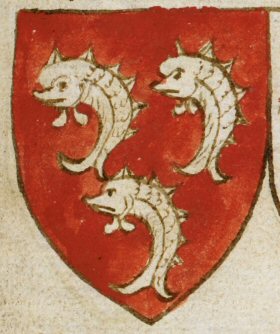
The earliest representation of Blennerhassett coat-of-arms known appears for John de Blenerhasset in an Ordinary of Arms known as Thomas Jenyn's Book (sometimes "Thomas Jenyn's Roll"), Queen Margaret's version.
This bound Ms. Ordinary or Book of Arms is believed compiled c1398 (21/22 Richard II) although one source states temp. Edward III (1327-1377) and another c1410.
Thomas Jenyn's Book is archived at the British Library Department of Manuscripts, document ref: Add. Ms. 40851, f.68 (p.126). The individual shield is numbered, No.1498. The roll has been microfilmed.
[BL Add.Ms.40581, f.68 (p.126)] [BL microfilm M2105 (monochrome)] [Boos TJ] [FCA] [HUDDLESTON p.28] [TG vol.5 p.98]
The arms are represented as: Gules three dolphins hauriant embowed Argent with a description in French:
"1498 John de Blenerhasset port de Gules a trois dolphins Argent", 1498 being the number of the shield not a date.
This is a rare instance of the early form of Blennerhassett arms, displayed without chevron.
The chevron has appeared on all Blennerhasett arms since 1390 - it may perhaps have been added to differentiate the family of a younger son at a time before Marks of Cadency had become standard to indicate such differences. There can be little doubt that the arms shown here, without a chevron, are the earlier form. |
|
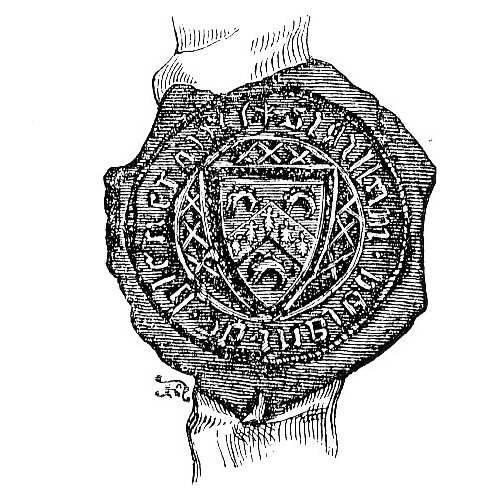
seal of Alan de Blenerhayset of Carlisle,
Cumberland (b.est.c1330 d.c1407).
Blennerhassett arms inside the legend"sigillum halani de blenerhay"
"the seal of Alan de Blenerhayset"
red wax seal 27mm diameter
attached to a deed in Latin dated
25-May-1390 (13 Richard II);
a lease by "Alano de Blenerhayset"
of waste ground by Carlisle Castle,
endorsed "Alanus Blenerhayset in fossa versus castrum"
Cumbria Record Office, Carlisle HQ
[CRO Ca/3/5/1/12]
Illustration from "Transactions of the Cumberland and Westmorland Antiquarian & Archaeological Society" vol.6 1883 pp.317-8 |
|
ancient Blennerhassett coat-of-arms arms
carved on a stone at
St Michael's Church, Workington, near Carlisle,
set into an interior wall near the west door.
History:
Workington Hall, also known as Curwen Hall,
is the ancient manor house of Workington.
Papers of "The Curwen Family of Working Hall" are at [TNA Ref. D Cu].
Blennerhassett connections with Workington:
1. Thomas Blennerhassett of Irthington
(a.k.a. Irdington, Yrdington) near Carlisle
m. Ann Curwen (daughter of Sir Thomas Curwen of Workington Hall who who d.c1470 and Ann (Alice?) Lowther, daughter of Sir Robert Lowther of Lowther).
2. Dorothy Blennerhassett, wife of Richard
Blennerhassett, mayor of Carlisle
(of St Mary’s parish, Carlisle c1555-71)
m. 2ndly Thomas Curwen.
3. Jane Blennerhassett (dau. of Edward & Janet Blennerhasset of Carlisle & Great Orton)
m. c1553 at Lamplugh, Cumberland
to John Lamplugh of Lamplugh Hall,
son and heir to Sir John Lamplugh Kt who was Sheriff of Cumberland 1537/8 (29 Henry VIII) and Isabella Curwen of Workington Hall
[N&B vol.2 p.38] [WHELLAN pp.327, 400].
His 1st m. (he m.2nd Isabel Stapleton). |
|
|
|
|
|
|
|
|
|
|
|
|
|
|
|
|
|
|
|
Clay tile or brick displaying the Blennerhassett arms between initials J M (John & Mary),
the date 1563 above.
Set into the exterior wall over a door to the old banqueting hall at Barsham Hall, Barsham, Suffolk.
The door has recently been converted to a window.
Barsham Hall was home to John Blennerhassett (b.c1515 d.1573) and his wife Mary Echingham. John was Treasurer and Minister (chief household officer) to the 3rd & 4th Dukes of Norfolk |
|
Arms of John Blennerhassett of Barsham, Co.Suffolk (b.c1515 d.1573) from his Will
dated 29-Jun-1573 (15 Eliz. I),
proved 3-Feb-1573/4 London [PCC]
Blennerhassett arms are here charged with an annulet, a Mark of Cadency used to indicate the family's descent from a 5th son
(Ralph Blennerhassett d.1475 of Frenze, Norfolk, was 5th son of Ralph Blennerhassett of Carlisle & Great Orton, Cumberland)
|
|
Arms of Blennerhassett
c1554 to 1599
Barsham, Co.Suffolk
from [SUCKLING/1]
and
[Holy Trinity Barsham Church Guide booklet,
2000 edition, inner front cover] |
|
|
|
|
|
|
|
|
|
|
|
|
|
photo: courtesy of Richard Mooney
|
|
|
|
|
|
Arms of Blennerhassett from a plate illustrating a volume of coats-of-arms, shield 329, plate 15.
engraved 1898 by R. W. Joyce and printed 1903 by Murphy & McCarthy. |
|
|
|
Throckmorton arms
"Gules, on a chevron Argent
three bars gemelles Sable"
(in a red field, a silver/white chevron containing three pairs of "narrow horizontal bars"
of colour black)
impaling
Blennerhassett arms |
|
mounted on a wall in the south aisle of
this formerly decorated the tomb of
Lionel Throckmorton d.24-Nov-1599,
(son of Simon Throckmorton & Anne Louthe)
whose 2nd wife Elizabeth Throckmorton
(nee Blennerhassett, of Barsham, Suffolk)
is also interred in this church.
Blennerhassett arms are here charged with an annulet, a Mark of Cadency used to indicate the family's descent from a 5th son
(Ralph Blennerhassett d.1475 of Frenze, Norfolk, was 5th son of Ralph Blennerhassett of Carlisle & Great Orton, Cumberland) |
|
Arms of Blennerhassett of Cumberland in
[Magna Brittania vol.4 Cumberland,
by Daniel & Samuel Lysons, 1816, Gentry pp.69-98] |
|
|
|
|
|
|
|
|
|
|
|
|
|
|
|
|
|
|
|
quarterly: 1st & 4th Blennerhassett,
2nd Lowdham, 3rd Orton
Arms on tomb of
John Blennerhassett
(d.27-Nov-1510) at the church of St.Andrew the Apostle, Frenze, Co.Norfolk.
Drawn 1816 by John Sell Cotman
[COTMAN vol.1, pl.50] |
|
quarterly: 1st & 4th Blennerhassett,
2nd & 3rd Lowdham
Blennerhassett arms are here charged with an annulet, a Mark of Cadency used to indicate the family's descent from a 5th son
(Ralph Blennerhassett d.1475 of Frenze, Norfolk, was 5th son of Ralph Blennerhassett of Carlisle & Great Orton, Cumberland)
on the tomb of Jane Tindall Blennerhassett
d.6-Oct-1521, widow of John Blennerhassett, at the church of St.Andrew the Apostle, Frenze, Co.Norfolk.
Drawn 1816 by John Sell Cotman
[COTMAN vol.1, appendix pl.5,
notes on p.60] |
|
quarterly: 1st & 4th Blennerhassett,
2nd & 3rd Lowdham - impaling Heigham
(one of four different shields on this tomb,
for the others see above)
Arms on tomb of
Sir Thomas Blennerhassett, Knt
(d.27-Jun-1531) at the church of St.Andrew the Apostle, Frenze, Co.Norfolk
Drawn 1816 by John Sell Cotman
[COTMAN vol.1, frontispiece pl.63,
notes on p.35] |
|
|
|
|
|
|
|
|
|
|
|
|
|
|
|
photo: courtesy of Joan Peck
|
|
|
|
1st & 6th Blennerhassett, 2nd Lowdham,
3rd Kelvedon, 4th Orton, 5th Skelton
Arms on tomb (grave slab) for
Mary Blennerhassett Culpepper Bacon
(d.17-Sep-1587) at the church of
St.Andrew the Apostle, Frenze, Co.Norfolk. Drawn 1816 by John Sell Cotman
[COTMAN vol.1, pl.83] |
|
Arms of Blennerhassett of Pockthorpe, Norwich, Co.Norfolk; showing vertical hatching lines used in heraldry to indicate the field is colour gules (red)
["Norfolk Genealogy" vol.6,
"Norfolk Pedigrees" p.18] |
|
Arms on the tomb of Edward Blennerhassett
(d. June 1641)
Campsea Ash, near Loudham, Co.Suffolk |
|
|
|
|
|
|
|
|
|
|
|
|
|
click on image to view complete page
|
|
|
|
|
|
Arms of Blennerhassett from a Garvey and Blennerhassett pedigree in
[Miscellanea Genealogica et Heraldica
v4 New Series 1884 pp.329-334]
Key:
ppr = Proper (in its natural colour),
g = Gules (red)
A = Argent (silver/white) |
|
Sketch of quarterly arms of William Glover,
of Frostendan Hall (formerly of High House, Campsey Ashe), quartered with the arms of Loudham and of his wife Anne Blennerhassett (dau. of Samuel Blennerhassett and sister of
Edward Blennerhassett who is interred in Campsey Ashe chuerch).
William Glover removed to Frostenden Hall and in 1626 presented to the church there. He died at Frostenden in 1628, age 83. The sketch is from "Visitation of Norfolk" (year?) [VoN plate III]
arms quarterly: 1st Glover, 2nd Blenerhassett
3rd Loudham, 4th Glover
--------------------
[1.] W[illia]m Glover: Frostenden, Suff[olk]
2. Blenerhassett
3. Loudham
[4. Glover]
"To London with his patent of Counboden.[?]"
Key:
g = Gules (red),
A = Argent (silver/white),
S = Sable (black)
Glover = "Sable, a fess embattled ermine
between 3 crescents Argent"
Blennerhassett = "Gules, a chevron ermine,
between three dolphins naiant embowed Argent"
Lowdham = "Argent, 3 escutcheons Sable" |
|
arms embossed on the cover of "The Life of Harman Blennerhassett"
by William Harrison Safford, 1850.
These arms also appear on Safford's
|
|
|
|
|
|
|
|
|
|
|
|
click on image to view surroundings
|
|
click on image to enlarge
|
|
|
|
|
|
Blennerhassett crest set into an exterior wall, over the main entrance door to Ballyseedy Castle
the wreath is coloured Azure & Argent (blue & white) |
|
Crest on ledger tomb of
Mary Blennerhassett Culpepper Bacon
(d.17-Sep-1587)
a part of her monumental brass, on a large marble ledger slab set into the nave floor at the church of St.Andrew, Frenze, Co.Norfolk. |
|
Drawing of the 1587 Blennerhassett crest on Mary Bacon's tomb at St.Andrew, Frenze, Co.Norfolk
(original is on left)
by John Sell Cotman 1816
[COTMAN vol.1 pl.83] |
|
|
|
|
|
|
|
|
|
|
|
|
|
|
|
 |
|
|
|
"a wolf sejant Gules"
Co.Norfolk & Co.Suffolk
© "Fairbairn's Crests of the Families of Great
Britain & Ireland" [FC]
(2 vols.) 1860/1911 edition 110, No.4 and 1905 ed. plate 29, No.3
These volumes were a continuation of the earlier "Book of Family Crests", of which the 11th ed. 1875 had this on plate 44, No.23) |
|
Blennerhassett crest
"a fox sejant Gules"
Co.Suffolk
© "Fairbairn's Crests of the Families of Great
Britain & Ireland" [FC] (2 vols.)
1860/1911 edition plate 87, No.4
does not appear in 1905 edition.
These volumes were a continuation of the earlier "Book of Family Crests", of which the 11th ed. 1875 had this on plate 31, No.28)
|
|
This is NOT a Blennerhassett crest, but is described as such by Fairbairn, in error:
"BLAVERHASSET, English, in dexter hand a hunting horn, sans strings, Proper, veruled, Or"
© "Fairbairn's Crests of the Families of Great Britain & Ireland" [FC] (2 vols.)
1860/1911 edition plate 109, No.3
& 1905 edition plate 217, No.4
These volumes were a continuation of the earlier "Book of Family Crests", of which the 11th ed. 1875 had this on plate 60, No.24) |
|
|
|
|
|
|
|
|
|
|
|
photo: courtesy of Monina Rogers
click on image to see cup
|
|
click on image to view the dish
|
|
|
|
|
|
Blennerhassett crest and motto on the Irish 1863 silver christening cup of
|
|
Blennerhassett crest on
Davenport porcelain dish c1820 |
|
This is NOT a Blennerhassett crest, but is described as such by Fairbairn, in error:
"BLENNERHASSET, Irish, in the sea a pillar, Proper"
© "Fairbairn's Crests of the Families of Great Britain & Ireland" [FC] (2 vols.)
1860/1911 ed. plate 14, No.3
1905 ed. plate 176, No.2
These volumes were a continuation of the earlier "Book of Family Crests" (2 vols.) but this crest did not appear in that work. |
| |
|
|
|
|
|
|
|
These two old wooden panels, in the past infected by woodworm, are set amongst other wall panelling covering the lower inside walls of the former library (now hotel bar) of Ballyseedy Castle (now Ballyseede Castle Hotel). The panel on the left displays the bust of a man wearing a helmet with fleur-de-lys crest. The panel on the right displays the Blennerhassett coat of arms, impaled by what appear to be the royal arms of England (three lions passant guardant), with Blennerhassett crest (a wolf sejant) above and date 1627 below.
The year 1627 significantly pre-dating the building of Elm Grove in 1721, one could be forgiven for assuming the panels were brought here from "old" Ballyseedy, now a ruin at the west end of Ballyseedy Wood. However, despite their primitive style of carving the concensus of opinion is that they are of more recent date, perhaps made to add interest and give the appearance of age to the library. The panel on the right probably commemorates the marriage of John Blennerhassett of Ballycarty & Ballyseedy (b.c1595 d.1676) with Martha Lynn (b.c1595/1600) who married "about 1630", but there is a difficulty with this attribution.
Martha was the daughter of George Lynne of Southwick Hall, Northamptonshire and his wife Isabella Forrest, daughter of Sir Myles Forrest of Morburn, Huntingdonshire. The arms of the Lynn (Lynne, Lyn) family are a single lion rampant (upright), described "Gules, a demi lion rampant Argent within a bordure Sable bezantee”, but the Lynn arms are not those used here. Instead the panel displays a shield bearing the arms of Blennerhassett impaling three lions passant (walking) - most probably (although not clear) this is three lions passant guardant (walking, facing viewer), the royal arms of England.
Use of the arms of England by an individual is not valid and officially such use was and is prohibited by the College of Arms. However, Martha Lynne was 10th in descent from King Edward III of England, through the families of Plantagenet, le Despencer, Beauchamp, Nevill, Throckmorton, and Lynn. Because of this every living bearer of the name Blennerhassett has a royal descent, a source of pride for the Blennerhassett family then and now, and it appears the person who commissioned the panel wished to show this pride publically, by representing the marriage to Martha Lynn by the arms of England.
That the family was proud of their Royal descent is demonstrated by Maj. Arthur Blennerhassett (b.1856 d.1939) of Ballyseedy, who paid an advance subscription to "Royal Descents" by Joseph Foster (published in 2 volumes 1887) [FOSTER/2] which ensured the book documented his Blennerhassett descent from Edward III via Martha Lynn. Thus it may be Arthur Blennerhassett who had these two panels made for his library, but no proof of this has been found.
NOTE: It was the same Arthur Blennerhassett who commissioned a "mock castle" refacing of the house, as was popular during the mid Victorian period, these changes causing what had previously been the front elevation and main entrance to become the rear of the house. This work, executed by Kerry architect, historian and Blennerhassett descendant James Franklin Fuller, caused the house to lose its Georgian elegance and simplicity but resulted in the impressive building we see today. Following these changes the house was referred to as "Ballyseedy House" or as "Ballyseedy Castle" in more-or-less equal measure. |
|
|
|
|
|
|
|
click on image to view surroundings
|
|
|
|
Blennerhassett crest & arms side by side on a dark oak fireplace surround in the great hall at Ballyseedy Castle (formerly Elm Grove) Co.Kerry . A Foundation Stone set in the wall above the fireplace carries a date 1721, when Elm Grove is believed to have been built. This fireplace surround was probably removed to Elm Grove from "Old Ballyseedy", now a ruin at the west end of Ballyseedy Wood. |
|
|
|
|
| |
|
|
click on image to view surroundings
|
|
click on image to view surroundings
|
|
click on image to view surroundings
|
|
|
|
Blennerhassett arms and crest decorating the rear (west face) of Ballyseedy Castle.
Prior to the 1880s remodelling by architect James Franklin Fuller, the west face was the front of the house, not the rear.
|
|
Two identical shields on stones set into exterior walls of the north wing of Ballyseedy Castle, one by each carriage entrance into the stable yard.
These record the remodelling initiated by Arthur Blennerhassett (b.1779 d.1815) and completed in 1821 by his son Arthur Blennerhassett (b.1799 d.1843), 100 years after the house was built.
1821 was also the year of Arthur Jr's marriage to Frances Deane Grady, daughter of Henry Deane Grady, but his wife's initials do not appear so is unlikely that it commemorates the marriage. |
|
This coat-of-arms, a shield with "a chevron reversed between in chief one lozenge and in base three lozenges" is on a stone set into the east facing exterior wall of a square tower at the front of Ballyseedy Castle, Co.Kerry. This tower appears to to have been added during the remodelling by Kerry architect James Franklin Fuller in the 1880s.
 These arms, and the A*B 1821 shield (see left) are unusual in having a reversed chevron, pointing down rather than up. These are not arms of Blennerhassetts or of any family the Ballyseedy Blennerhassetts married into. These arms, and the A*B 1821 shield (see left) are unusual in having a reversed chevron, pointing down rather than up. These are not arms of Blennerhassetts or of any family the Ballyseedy Blennerhassetts married into.
Robert Noel, Lancaster Herald at the College of Arms in London, tells me he can find no trace of these arms and suspects they are imaginary.
It is curious that no Blennerhassett arms appear on the East face, the new front of the house, while these meaningless but highly visible arms do appear there. It is possible that the 1880s remodelling of the house took place in the absence of the owner, Charles Blennerhassett, and that a rough sketch indicating the intended position of the Blennerhassett coat of arms was interpreted literally by the mason who had no detail drawing of the arms to follow.
Blennerhassett arms do appear on the west face or rear of the house (see image to left).
Square tower at Ballyseedy in 2004 and 2006
|
|
|
|
|
|
|
|
|
|
|
|
|
|
click on image for further information
|
|
|
|
|
|
Blennerhassett of Ballyseedy, Co.Kerry
© "Burke's Landed Gentry of Ireland" [BLGI]
by Sir Bernard Burke, 1899, 1904, 1912
reproduced in "Irish Book of Arms" I.G.F. 2001 |
|
Headstone for Sir Rowland Blennerhassett of London, 4th Bart. of Blennerville in Co.Kerry (died 22-Mar-1909) in St. Benedict's churchyard, adjoining the main gate to Downside Abbey & School, Co.Wiltshire |
|
Blennerhassett of Blennerville,
with Baronetcy badge
© "Debrett's Illustrated Baronetage" [DEBRETT] 1899 p.52 |
|
|
|
|
|
|
|
|
|
|
|
Blennerhassett of Blennerville,
with Baronetcy badge
© "The Baronetage and Knightage of the British Empire" [FB]
by Joseph Foster, 1881 vol.1 (of 2) p.51 |
|
Blennerhassett of Blennerville, Co.Kerry
with Baronetcy badge
© "Burke's Peerage, Baronetage & Knightage" [BP]
by Sir Bernard Burke, 1938-1970 |
|
Blenerhassett of Blennerville, Co.Kerry
with Baronetcy badge
© "Burke's Peerage, Baronetage & Knightage" [BP]
by Sir Bernard Burke, 1999-2003
& © "Debrett's Illustrated Baronetage" 1990 p.B91 [DEBRETT] |
|
|
|
|
|
|
|
|
|
|
|
|
|
|
|
|
|
|
|
image: courtesy of Geraldine Pardoe |
|
arms "ratified and confirmed" to Rowland Blennerhassett of Blennerville, Co.Kerry on
13-Aug-1808 (before he was
granted the Baronetcy on 2-Sep-1809) |
|
arms: Thompson of Clonfin, Co.Longford, quartered with Blennerhassett
crest: Thompson
upper motto: Blennerhassett
lower motto: Thompson
|
|
|
|
|
|
|
|
|
|
|
|
|
|
|
|
three modern renderings of Blennerhassett Arms
|
|
|
|
|
|
|
|
|
|
|
|
image: courtesy of Leslie Blennerhassett |
|
image: courtesy of Eddie Geoghegan
|
|
image: courtesy of Linda Watson |
| |
|